
The Independent Fleet (1932-1939)
Roster
Other ways to view the above table:
Excel Download | Printable (PDF)
Description
The pre-war fleet of subway cars built for the city's Independent Subway under contracts R-1, R-4, R-6, R-7, and R-9 (collectively known by subway fans nowadays as the R-9s or "arnines") consisted of 1,703 nearly identical cars, numbered 100-1802, delivered between 1930 and 1940. When the first order of 300 cars, under contract R-1, was announced, the Electric Railway Journal reported in November 1928:
The New York City Board of Transportation announced today that it will soon advertise for bids for the construction of 300 steel cars for service on the Eighth Avenue-Central Park West-Washington Heights line of the new subway system. ... For nearly a year, the members of the board and its engineers have been consulting and conducting research on the design of a steel car. As a result it is expected that the cars of the city's new subway system will afford greater capacity and facility, will be faster in operation and have less crowding for the amount of traffic anticipated than other cars now in use in the city.
The new cars, as designed, will be 60 ft. 6 in. long, 10 ft. wide and 12 ft. high. The length will be 9 ft. and 2 in. longer than the Interborough Rapid Transit Company cars and about 7 ft. shorter than the single steel cars now used by the Brooklyn-Manhattan Transit company. They will permit easy movement of passengers through the end doors between cars, while the train is in motion. The width and height of the new cars will be the same as the width and height of the Brooklyn-Manhattan Transit company cars. The new cars will have four double doors on each side, each doorway being 3 ft. 10 in. wide. ...
The arrangement of the seats is somewhat similar to the arrangement now in existence in the B.M.T. cars, but in the city's new subway cars there is to be 2 in. more knee room between crossseats than in the B.M.T. cars. Each car will seat 60 passengers, and when filled with a standing load, each car will have a capacity of 282 passengers. The station platforms are 660 ft. in length, enough to accommodate a train of eleven cars, nearly 30 per cent more than the longest B.M.T. train and 55 per cent more than the present Interborough trains of ten cars each.
The cars will be provided with white-enameled hand straps in front of the seats and vertical stanchions near the doors. The seats will be of heavy, natural-colored rattan. Illuminated route or destination signs will be installed on the sides and at both ends of cars. These signs will carry a designated route number indicating the particular line the train is operating over similar to route numbers now in use on some of the bus lines. Each car will be equipped with five ceiling fans. The equipment of each car such as doors, fans, lights, etc., will be connected to permit operation from one or more positions between cars on the train.

The Eighth Avenue line of the Independent wasn't to open until 1932, and the line to Queens not until 1933. Without a subway line to run them on, the first delivery of R-1 cars was tested on the BMT's Sea Beach line in 1931. In October, 1931, a second order of identical cars was placed. Electric Railway Journal reported:
The cost of 300 additional [R-4] cars fully equipped for service on the... new city subway system will be about 27 per cent less than that of the 300 cars [R-1] ordered eighteen months ago, according to the Board of Transportation.... The lowest bid of $6,326,400 for the construction of 300 was submitted by the American Car & Foundry Company, the builder of the first 300 cars. Board of Transportation engineers calculate that the contract awards on the basis of the lowest bids would provide 300 fully equipped cars for $8,546,400, or $28,488 per car, as compared with $11,376,397, or $37,921 per car, for the order of eighteen months ago.
Further orders for nearly identical cars were placed under contracts R-6 (three subcontracts), R-7 (four subcontracts) and R-9 (two subcontracts). Most of the cars were retired by 1970, with a few soldiering on until March 31, 1977, when the remaining cars of contract R-9 were operating on the BMT Eastern Division (today's J line).
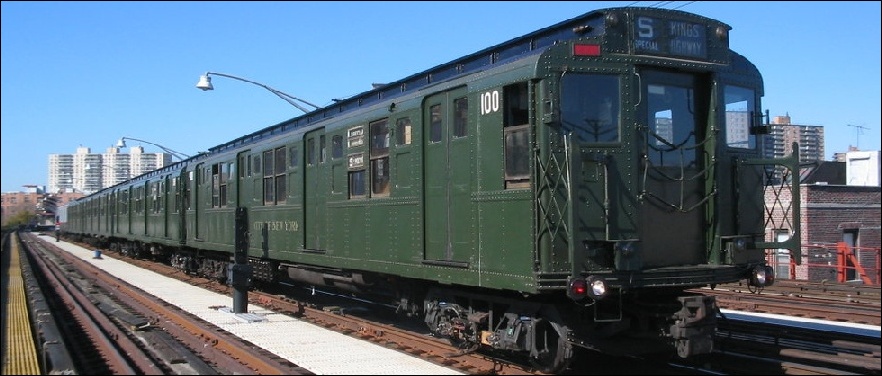
Several cars of the "Arnine" fleet have been preserved on NYCT property, or at other railroad museums. Cars 100, 484, and 1575 were the core of the New York Transit Museum's initial exhibit when the museum opened in 1976. These cars remained on static exhibit there until 2003, when these three cars operated a charity fan trip. Since 2003, several other "Arnine" cars have been restored to operable condition, and the museum train now consists of: 100, 381, 401, 484, 1000, 1300, 1575, 1802. Cars 103, 923, and 925 are also retained on the NYCT property for parts or future restoration. Operable "Arnines" are also included on the rosters of the Seashore Trolley Museum (800, 1440) and the Shore Line Trolley Museum (1689). See below for more details of preserved cars.
Related Documents
They Moved the Millions, Chapter 4, The Independent System, a more extensive description of the R-1/R-9 type cars is provided in Ed Davis's They Moved the Millions.
Loading Speed A Major Factor in Design of New York Subway Cars (1931), Electric Railway Journal's description of the new Independent subway cars.
Datasheets

| Length over Anticlimbers 60' 2.5" |
Width at Door Sills 10' 0" |
Total Weight 84,000-84,500 lbs. |
Height from Railhead 12' 2" |
Height, Railhead to Floor 3' 9 1/8" |
Seating Capacity 56 |
Photo Gallery
| Five Random Images | ||||
 Image 1765 (209k, 1024x673) Photo by: Joe Testagrose Location: Knickerbocker Avenue |  Image 24574 (249k, 1024x682) Collection of: David Pirmann Location: Avenue J |  Image 34226 (204k, 1024x666) Photo by: Steve Zabel Collection of: Joe Testagrose Location: Coney Island Yard |  Image 119460 (165k, 1024x679) Photo by: Steve Zabel Collection of: Joe Testagrose Location: 207th Street Yard |  Image 150644 (511k, 1220x801) Photo by: Stewart Milstein Location: Williamsburg Bridge |
Car Notes
| Green | Preserved, saved for preservation, or exists in some state |
Yellow | Converted to work service (and later scrapped or still in use) |
Red | Wrecked/Damaged in accident (and possibly repaired), or scrapped prior to the bulk of the type |
| Number | Notes | ||||||||||
|---|---|---|---|---|---|---|---|---|---|---|---|
| ... | Several cars converted to work motor service, numbers M520-M529. | ||||||||||
| ... | Several cars converted to work motor service, numbers M503-M506, M551-M556, M900-M920. | ||||||||||
| ... | 100 cars of the R9 fleet underwent work in the mid-1970s pertaining to the air compressors. This was done to test the viability of extending the life of the fleet. There would be five groups of 20 cars each, with the following modifcations made:
A-00 - A-19 will get new air piping and new D-3 air compressors; B-20 - B-39 will have air lines cleaned and new D-3 compressors; C-40 - C-59 will get new air lines and overhauled D3F air compressors; D-60 - D-79 will have air lines cleaned and overhauled compressors; E-80 - B-99 retain serviceable compressors and a record of low airconsumption. The modified cars could then only run with like-modified mates. The renumbered cars are listed below: A-00 ex-1800; A-01 ex-1799; A-02 ex-1798; A-03 ex-1797; A-04 ex-1796; A-05 ex-1755; A-06 ex-1754; A-07 ex-1753; A-08 ex-1752; A-09 ex-1751; A-10 ex-1737; A-11 ex-1789; A-12 ex-1779; A-13 ex-1772; A-14 ex-1787; A-15 ex-1659; A-16 ex-1654; A-17 ex-1655; A-18 ex-1651; A-19 ex-1658; B-20 ex-1709; B-21 ex-1702; B-22 ex-1703; B-23 ex-1705; B-24 ex-1717; B-25 ex-1720; B-26 ex-1734; B-27 ex-1727; B-28 ex-1730; B-29 ex-1725; B-30 ex-1735; B-31 ex-????; B-32 ex-1742; B-33 ex-1740; B-34 ex-1750; B-35 ex-1743; B-36 ex-1757; B-37 ex-1733; B-38 ex-1748; B-39 ex-1741; C-40 ex-1673; C-41 ex-1674; C-42 ex-1664; C-43 ex-1667; C-44 ex-1679; C-45 ex-1684; C-46 ex-1680; C-47 ex-1675; C-48 ex-1685; C-49 ex-1683; C-50 ex-1657; C-51 ex-1650; C-52 ex-1672; C-53 ex-1652; C-54 ex-1656; C-55 ex-1661; C-56 ex-1662; C-57 ex-1663; C-58 ex-1665; C-59 ex-1670; D-60 ex-1711; D-61 ex-1708; D-62 ex-1706; D-63 ex-1704; D-64 ex-1707; D-65 ex-1712; D-66 ex-1721; D-67 ex-1713; D-68 ex-1718; D-69 ex-1722; D-70 ex-1719; D-71 ex-1714; D-72 ex-1716; D-73 ex-1715; D-74 ex-1732; D-75 ex-1726; D-76 ex-1723; D-77 ex-1729; D-78 ex-????; D-79 ex-????; E-80 ex-1686; E-81 ex-1687; E-82 ex-1691; E-83 ex-1724; E-84 ex-1728; E-85 ex-1738; E-86 ex-1739; E-87 ex-1746; E-88 ex-1747; E-89 ex-1749; E-90 ex-1758; E-91 ex-1761; E-92 ex-1762; E-93 ex-1767; E-94 ex-1776; E-95 ex-1778; E-96 ex-1781; E-97 ex-1792; E-98 ex-1795; E-99 ex-1801.
| ||||||||||
| 100-144 | Included carbon manganese side sill stiffeners. | ||||||||||
| 100 | Operational. New York Transit Museum collection. Used in R-1/R-9 museum train. Used on first R-type fan trip in many years on 6/8/2003.
| ||||||||||
| 103 | Operational. Owned by Railway Preservation Corp. Part of "Arnine" museum train. Had experimental Axiflow fans installed in 1947. Restored to operational service in 2017-2019, and operated first Nostalgia Train trip on December 29, 2019.
| ||||||||||
| 165 | This car was cut in half, lengthened to 75', and renumbered XC675. It was run throughout the system (and SIRT) in order to find areas of tight clearance, in anticipation of ordering the R44 fleet in 1971.
| ||||||||||
| 170-176 | Cars converted in summer 1968 to alcohol sprayer cars, numbers AL470-AL476.
| ||||||||||
| 175 | Not operational. Seashore Trolley Museum collection. Stripped, truckless, and used only for storage. Two of its side doors were donated to the restoration of R-4 491.
| ||||||||||
| 192 | This car was cut in half, lengthened to 75', and renumbered XC575. It was run throughout the system (and SIRT) in order to find areas of tight clearance, in anticipation of ordering the R44 fleet in 1971.
| ||||||||||
| 212, 378, 472 | Scrapped after collision 2/17/1936. | ||||||||||
| 273 | Wrecked in early 1960, scrapped 6/27/1960.
| ||||||||||
| 381 | Operational. Owned by Railway Preservation Corp., stored at Coney Island Yard. Used in R-1/R-9 museum train. Restored to operating condition in 2004 and used in the Transit Museum's museum train parade weekend of 10/23-24/2004.
| ||||||||||
| 399 | Converted to work motor M-502, summer 1968.
| ||||||||||
| 401 (aka 491) | Operational. New York Transit Museum collection. Used in R-1/R-9 museum train. Formerly used as a training car at Jamaica Yard and numbered 491. Was moved to Coney Island in 1998 for restoration. Two missing side doors were provided by R-1 175.
| ||||||||||
| 404, 690, 973, 980 | Involved in collision near Church Avenue, 6/27/1967. 404, 973, 980 seriously damaged. | ||||||||||
| 467 | First first-generation IND subway car to be retrofitted with headlights, in 1962. | ||||||||||
| 484 | Operational. New York Transit Museum collection. Outfitted with "bullseye" lighting and experimental PA system in 1946. Used on the first R-type fan trip in many years on 6/8/2003.
| ||||||||||
| 744 | Outfitted with "bullseye" lighting and experimental PA system in 1946. | ||||||||||
| 800 | Operational. Seashore Trolley Museum collection.
| ||||||||||
| 825 | Not operational. Trolley Museum of New York collection.
| ||||||||||
| 923, 925 | Not operational. Converted to revenue collection cars R247, R248. Owned by Railway Preservation Corp., stored at Coney Island Yard.
| ||||||||||
| 978 | The carbody of R-6 978 lived at Golden's Deli, in the Staten Island Mall, 2845 Richmond Avenue, from 1985 to January 2012, when the deli closed. On 1/11/2012 the car was removed from the site. In 2020 a newspaper article in the Middletown, NY, Times Herald-Record revealed that the carbody has been relocated to a transportation enthusiast's private home in Warwick, NY.
| ||||||||||
| 983 | The carbody of R-6-3 983 was recently rediscovered on private property in Jacksonville, FL. It was being used as a storage shed. In 2013, the car was purchased by, and transported to the Craggy Mountain Railroad in Woodfin NC, which will attempt to restore it.
| ||||||||||
| 986 | Collided with "A" train outside Hoyt St., 7/17/1970. | ||||||||||
| 1000 | Operational. Stored at Coney Island Yard for many years; owned by Railway Preservation Corp. Restored to operational status and operated first Nostalgia Train trip on 8/2/2009.
| ||||||||||
| 1079 | Scrapped, no other info available, 7/1958. | ||||||||||
| 1144 | Survives at Buckinghamshire Railway Centre, England, United Kingdom. 1144 info page at BRC.
| ||||||||||
| 1192 | Scrapped, no other info available, 8/1958. | ||||||||||
| 1208 | Car 1208 had been restored as part of the museum fleet but was scrapped in the 1980s. It would have been the only restored Pullman-Standard car in the museum fleet.
| ||||||||||
| 1236 | Accident at Church Ave. on 2/12/1973 with R40 4420; the R40 was demolished. | ||||||||||
| 1300 | Operational. Owned by Railway Preservation Corp.; stored at Coney Island Yard. Moved to 207th Street Yard in 2004 for restoration; ran first trip 8/21/2005 on a Transit Museum Nostalgia Train ride to the Rockaways.
| ||||||||||
| 1440 | Operational. Seashore Trolley Museum collection.
| ||||||||||
| 1575 | Operational. New York Transit Museum collection. Car 1575 was involved in a wreck in 1946, and was then overhauled into the R-10 prototype car. The prototype work involved body and interior only, not mechanics. 1575 re-entered service 6/30/1947, but was only able to run with other R-1/R-9 types, never with R-10 cars that it resembled on the exterior. Operated the first R-type fan trip in many years on 6/8/2003.
| ||||||||||
| 1689 | Operational. Shore Line Trolley Museum collection.
| ||||||||||
| 1761 | Runaway in East New York Yard, 12/3/1972. Repaired and returned to service.
| ||||||||||
| 1801 | Not operational. New York State Museum collection, Albany, New York. Moved to the museum from Coney Island 1979 or 1980.
| ||||||||||
| 1802 | Operational. Owned by Railway Preservation Corp. Stored at Coney Island Yard for many years. Restored to operating condition and operated with the other R-1/R-9 museum cars in holiday service beginning 11/27/2004.
|


| ||||||||||||||||||||||