
Chapter 10, The Space Age on Rails
They Moved The Millions · by Ed Davis, Sr.

Here is the set of R44's at Jamaica Station on the Long Island Rail Road. Subway track was unsuitable for high speed tests so the LIRR's electrified trackage was used.
Section A: A New Breed; the R44
The delivery of the R42's had completed two decades of rolling stock built on the same general principles. It was thought among high transit engineering officials that the SMEE braking system and other features of those cars had become dated and time was ripe for more modern, highly technical equipment. Another matter related to development of the next breed of new cars for the transit system was the fact that the cars that had been delivered for IND and BMT routes from the R-1 thru the'R42 did not make full usage of available clearances for the lines they ran on. At 60 feet long they were smaller than the older BMT A-13 cars which were 67 feet long and would fit on either division. In other words, more cars than necessary were being used for the service. Wouldn't use of a 67 foot car in nine car trains make more sense and be cheaper than 10 shorter cars? Was it possible to run longer cars yet and use still fewer? Such as eight 75 foot cars!
The Electric Railroaders Association, a railfan group based in New York City, had suggested often in their publication "Headlights" that longer cars be built for the combined BMT-IND or "B" Division. There were some Transit Authority officials who belonged to or had friends in the ERA and it was possible that they were influential in this matter. Plans were underway in 1969 to engineer more new cars for the "B" Division, and as part of the planning for the new cars there was a test train assembled to check "B" Division clearances to see whether or not 75 foot cars could indeed be run, and where modifications to structures would be necessary to clear these larger cars.
Retired R1-9 cars were used to make up the test train, one was cut in half and structural members added in the middle to stetch its length to 75 feet, but it was not a completed 75' car; rather the center section was open and narrower, much like a flatcar in the center. Feelers were mounted which would strike areas of no clearance. Another 75 foot car was assembled to test interplay in ride between two 75' cars. The tests were relatively successful, it was proven that 75' cars could be used, and only in minor ways were structural changes necessary. In some areas "no clearance" signs and warning boards had to be mounted so that workmen would not stand in those area when a train was approaching, lest the tremendous end excess or center excess of these long cars send them to railwaymen's heaven. A good idea, these longer cars; fewer of all types of equipment to maintain, and fewer cars to purchase initially. In service there were a few problems that this long length would bring, such as end doors of cars having to remain locked; passengers of the system under most circumstances were accustomed to passing between cars to find seats or to be nearer the exit at their station. With the old BMT A-B's and in general practice on the BMT end doors were locked and passengers could not pass between cars. The reason was the great end excess (overhang past the trucks) which, when negotiating some curves or going thru crossovers would have the car ends move in a way which would crush a hapless passenger walking between cars. So, as was done on the old A-B's, end doors of the R44 remained locked when the train was in service.
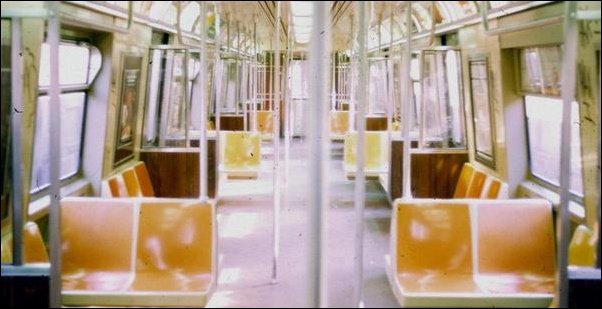
Interior of the R44! Most pleasant, with bright lights, pastel colors, and seating similar to that of the earlier cars. Swinging standee handholds have been supplanted by poles.
Bringing up the matter of this inconvenience is a bit premature, but has been done so as the great majority of the mechanical features of the R44 need to be studied. The concept of long cars was a good idea; we will study the mechanics of them shortly.
St. Louis Car Company delivered 352 cars of the R44 contract; 300 for the "subway", or transit system, and 52 cars for the outdoor Staten Island Rapid Transit System, a former Baltimore and Ohio Railroad subsidiary now owned and operated by a wing of the Metropolitan Transportation Authority which ran the subways, most city buses, and several other passenger facilities.
The first cars were delivered in mid 1970 but did not see passenger service until the end of the year. They were run in exhaustive tests for those several months between, and their first runs in service were a series of trials on the A, D, E, and F lines. It didn't take long to see that these new cars would have not only "teething problems" but there were several deficiencies in them.
In addition to the trials on the system there were high speed trials on the Long Island Railroad where a speed of 83 MPH was attained. As the transit system did not have good enough trackage for such speeds tests were conducted on the Long Island. In fact they never would be operated at such speeds on their own turf. A fact which was never released to the public was that high speed operation blew half the traction motors out on them.

R44 on the "A" train. This elevated portion of the line was on the former BMT Fulton St. elevated, last surviving portion of the line. This R44 was nearly new then. The 75 foot length of this car is most prominent in this picture.
For traction power the R44 had four 115 HP motors, as compared to four 100 HP motors on the smaller cars. Controls were set up so that they could be controlled as existing cars were, with the three power points in the manual mode, or they could be run in a regulated mode, by setting the controller for the speed desired and speed would be automatically controlled. They were also equipped for fully automated operation, but the system does not have equipment for automatic train operation nor cab signals and very likely won't for a long time into the future. The control group on these cars was a solid state "chopper" system which had been tested on existing "SMEE" cars before the R44's were built. This replaced the electro-pneumatic and electric systems used previously. As a departure from most prior orders where electric equipment was ordered in equal amounts from Westinghouse and General Electric, the R44's were all Westinghouse. However, as the Long Island M-1 cars were all GE there was no cause for dispute on GE's part. The R44's never have run in service in any mode other than manual for some reason; their successors, the R46's have been run in regulated mode which is nearly all automated except that the motorman sets the control.
The braking system on the R44 was entirely different. There was no brake valve (this was nothing new, other transit cars such as the Long Island M-1 had power and brake on one control) on them: movement of the controller forward past "coast" position would call for power, movement back from "coast" would call for service braking in varying degrees and finally, emergency. Control of the service brake was electronic, by reducing amperage of a trainline "P" wire service brake would apply dynamically and pneumatically (these still had wheel tread brakes) in proportion to lowering of "P" wire current; total loss would bring on full service braking. There was also a brake pipe on these trains for emergency features. Loss of brake pipe pressure would of course bring about an emergency application. As there were no feed valves on these cars full main reservoir pressure of up to 160 lbs would charge the brake pipe; a minimum pressure of 125 lbs was eventually established for keeping a train in passenger service. As on the SMEE cars, if a car was a "dead motor", meaning traction motors were inoperative, there would be no dynamic brake and tread brakes would automatically apply in place of the dynamic when braking was called for by the motorman. The R44 was the first group of cars to be built with composition brake shoes rather than cast iron which had been universally used by railroads until shortly before this time. The Authority had experimented with composition shoes on both SMEE and AMUE equipment a few years before the R44's were ordered. It was found that since compositon shoes did not heat up as cast iron ones did, that when running outdoors trains could run past station platforms in snowy or extreme cold weather due to ice buildup on brake shoes. As had been established on the Long Island Cars, a snow brake feature was installed, which, by simple operation of an electric control switch, light brake cylinder pressure would keep brake shoes against the wheels and prevent the ice problem.
The H2c coupler which had been nearly standard on the system was not used on these cars. Ohio Brass hook couplers were used which were not compatible with existing equipment and in case an R44 became disabled and had to be pushed, if another R44 was not behind a coupler adaptor would have to be used to make a coupling. Of course air lines could not be connected and brakes on the R44 would not be controlled by the train pushing.
There was a feature on these cars which was supposed to prevent wheel sliding, therefore flat spots on wheels. It was called a decelostat and if this device sensed a slide brake pressure would be reduced. Despite this the R44's were no strangers to flat spots!
The cabs were full width, the entire end (number one end) of the "A" car which had controls, air compressors, main reservoirs, and low voltage devices was closed to passengers as it had been on the old IRT Gibbs cars. The number two end had no cab, and neither end of a "B" car had a cab. This A and B arrangement was exactly the same as had been used on early diesel road units, which we will explain soon. The motorman or conductor, whoever happened to be using a cab, had the entire full width cab to themselves. Each cab had both conductors and motorman's controls. There was now an intercom system between the conductor and motorman as well.
All side route signs were changed by motors using a computer coded number set by a selector which would change signs by remote control. This feature had been tried on the BMT Multi-s in the 1930's, but of course was not as technical. The end signs were motor driven too, key operated by motor- man or conductor.

A pair of R46's appear in Bicentennial colors on BMT trackage. Nice to see two neat cars; coupled behind these are the usual graffiti-desecrated cars. Franklin B. Roberts.
There were A and B cars in these R44's and the R46's. There were couplers at both ends of these cars so they were single cars rather than married pairs. They could be assembled in sets of AA, ABA, or ABBA like the old "covered wagon" diesel locomotives. The A car, as we have mentioned had the air and low voltage equipment and was a complete car but could not be run singly as one end was blind. At least two "A" cars had to be used. The "B" cars had traction motors, control group, air reservoirs, and brake control equipment, all of it controlled by trainline. Whether this system was better than the married pair system is debatable; the best system of course is to have all control cars with controls at both ends but of course this is more expensive to build and maintain.
Interiors on the R44's were a delight compared to what had been. The combination transverse and longitudinal seating pattern as used on the R1-9, and other cars, had returned. Colors were a pleasant pastel with simulated wood grain panelling in areas. One train was even equipped with carpeting but there are too many people in New York City who cannot respect good things and this was a foolish idea that soon came to an end. One thing not readily apparent but would save commuters much grief was the single door operating units. Whereas it had been practice to have one door engine or motor to control two leaves or panels, on the R44 each door had its own motors. If one motor failed only half a panel or doorset would fail, thereby allowing less loss of time for such a problem. Another new feature regarding door equipment appeared: where all prior equipment had a light to show which car had a door open or unlocked, the R44 (and R46) had a light at each door motor to show which was bad order, or open. The light would remain lit at a trouble door.
The R44's were plagued by mechanical difficulties, never made time as well as the "SMEE" cars, built from the postwar era on, and due to such things as air conditioner brackets breaking and having to be replaced, and other retrofitting programs as well, the R44's were a constant headache, and to the delight of many railbuffs, the careers of the cars were being prolonged during these retrofitting programs. Many of the "failsafe" features on these cars acted when systems, particularly the service braking system, failed and due to those "failsafe" features many prolonged breakdowns resulted as neither operating men, shop personnel, nor supervision were properly trained to overcome these difficulties.
Another silly idea built into the R44's was a chime that would ring when the conductor pushed door closing buttons, then a four second time delay before doors closed. This was another time consuming device; fortunately the time delay feature was removed.
One train of R44's was built with hydraulic rather than pneumatic brake but happily this idea was soon done away with and not repeated.
The R44's were placed in service on the A, D, E and F lines, except for the 52 cars that were built for Staten Island. Many more R1-9 cars were retired during their deliveries until 1972. The R44's in Queens eventually were transferred to the "A" line when the R46's were delivered and replaced the R1-9 Rio's there which had served there nearly exclusively for almost 20 years. If the R44 was a disaster mechanically and impractical in many ways at least they were an effort to make travel more attractive on the system and were a change from the cold efficiency of cars of the R10 thru R42 classes.
Section B: The Last of the Original Rolling Stock Goes to Heaven
The R44 was not in any way a successful order of cars. The St. Louis Car Company which built them, and indeed had built the great majority of cars for the system for nearly 20 years, was financially embarassed for having to make good on warranties, and because of the losses incurred went out of business. It might do to mention that the Budd Company, which built the Long Island Railroad's M-1 cars which were an earlier cousin to the R44, had temporarily gone out of business, also because the M-1's had a lot of bugs that had to be ironed out and cost a lot of money. Budd was later reorganized and is now controlled by German interests. A similar fate was to beset Pullman Standard after the construction of the R46 cars, except that they did not go out of business; they managed to complete a troublesome order for Amtrak (Superliner cars) and then quit building passenger equipment. They are still very much into building freight cars, however. Strange that orders for the Metropolitan Transportation Authority divisions caused builders so much grief, as high-technology cars do exist in other countries; they also exist in the United States but regrettably the bulk of passenger equipment these days (except for Amtrak) is imported. Two aircraft companies had tried their hand at building railcars: Boeing (Vertol Division) in building the new concept streetcars known as LRV's, and Rohr, who built the BART cars for San Francisco. Both of these fleets of cars were also quite troublesome and neither of those builders exist today. Canada happily has been holding its own. In this country most self-propelled rail equipment has come from Europe or Japan. A very sad state of affairs for our great land that once showed the rest of the world how to make things good. Amtrak had to order electric locomotives (built by General Motors under license) from a Swedish design. What ever happened to the brains that developed the GG-1 locomotive on the Pennsylvania, and generations of electric railway equipment? The most reliable rail equipment (powered) these days is the General Motors diesel locomotives. Unfortunately that is where it ends.
Enough of the sob stories! While the R44's were putting both transit officials and operating men thru misery trying to get them to run satisfactorily and maintain service, another order of new cars was planned very much like the R44's. Contract R46 was awarded to Pullman Standard, for some 750 cars, and was in fact the largest single order of rapid transit cars ever placed. Very likely it holds a close second place to the Long Island Railroad M-1 order of 770 cars (suburban commuter cars). Deliveries began in 1975, and the R46 definitely showed themselves to be better performers than the R44. At least in the beginning, anyway. They were much faster than the R44's and it really seemed that they would be a good piece of equipment.
As if the excessive sophistication of the R44 did not teach the Transit Authority's engineers a hard lesson, nor had the high transit officials and city officials put a hold on such rolling stock, the R46 was even more highly sophisiticated, although they were very much similar to the R44's.
It was hard to tell an R46 from an R44. The Pullman built bodies appeared somewhat better built and the number plate and end signs were slightly different, but that could be easily changed. The simplest spotting feature was under the cars. The conventional truck used by the system for over 25 years which resembled a standard streamline passenger car truck, and which was present on the R44, did not appear on the R46. The General Steel Industries truck had been replaced by a newer design from Rockwell International which also manufactures locomotive trucks. This truck had an air suspension system which was alright until an air spring ruptured, then the whole train would have to be taken out of service, its speed restricted to 10 MPH. Due to traffic conditions on the system bad order cars cannot be set out, so a whole train is lost to prevent worse delays. While air spring ruptures were not a common problem, the Rockwell trucks in time began developing cracks and it was a constant headache to keep repairing them, not to mention a great expense. The end result of this was a lawsuit againt the manufacturer. Strange that these outboard bearing, apparently heavy duty trucks were so weak when many other systems used an inboard bearing truck that looked much weaker.
The R46's had all General Electric equipment whereas the R44's were Westinghouse. Perhaps the GE control system was superior as the R46's were run in the semi-automated "regulated" mode in service whereas the R44 were being run much like older equipment, in the manual mode. This is subject to thought though.
There were few other major modifications on the R46. One notable feature was the electric charging system of the brake pipe; for the first time on any equipment for the system the brake pipe was charged in each car simultaneously, and a train of any length would have full brake pipe pressure within a matter of a few seconds. A charging magnet valve would charge the brake pipe from each car where on all prior equipment pressure would be built up while charging from the first car, or other operating position in emergencies. In this respect they were only semi-compatible with the R44's, they could no doubt be run together in some circumstances but in passenger service were not mixed in trains.
Another nonsensical thing showed upon the R46. When an end door was opened a horn would sound at the location it was opened at. This same horn would also sound at a location where an emergency cord was pulled to aid in locating the open valve. It would have made a lot more sense to mount the exhaust pipe from that valve in a way that blowing air could be heard which had been the practice in the past. But it seems apparent that if it wasn't some novel idea the planners didn't want it and the whole concept of engineering on both the R44 and the R46 and its resultant inadequecy for the service required proved everyone involved was wrong.
When the R46's were first delivered they were placed again on the Queens lines of the IND which seemed to be where the new equipment usually went. They were used on all lines there including the N line which was actually based on the Southern section of the former BMT, out of Coney Island. They have remained in Queens for the most part. Delivery of the R46's resulted in the retirement of all remaining R1-9 class cars on the system, and now there were none of the pioneer cars in regular service anywhere on the New York City Transit System. Despite all this service has gotten progressively poorer, although there have been occasional improvements. As service on some lines was reduced, and some lines were abolished, before all the R46's were delivered, all of the R1-9 cars were retired early in 1977. As more new cars were delivered many of the R16 cars were placed in storage, and by this writing in the summer of 1984 some R10 and R16 cars have been scrapped. There has been talk of more new cars being built for the B Division but priority has been placed in the IRT for now which had the most deteriorated equipment. Until some older cars were retrofitted with air conditioning, the IRT had virtually no air conditioned trains. It will be interesting to see what the next new cars on the "B" division will look like, but as new A Division, or IRT, cars are being built in a manner more like the stock which preceded the R44 it is likely that new B Division cars will also be more like an R42. Perhaps the long car (75 foot) concept will be preserved, however.
|
Jamaica Yard in 1977. A train of R46's predominates in this scene. The yard is shared by R44's, R46's, R40's, R38's, R42's and even some R16's which do not appear here. |
An almost new train of R44's prepares to leave Bedford Park terminal on the "D" line in 1972, bound for a long run to Coney Island. |
|
A train of R44's leaves 80th St. on the "A" line, on former BMT trackage. Wooden cars from the 1890's once ran here! |
A hundred years before the last R46's were delivered - rapid transit in New York was by steam power. Here two trains of wooden coaches meet on the el, hauled by steam locomotives. (An old viewing slide.) |


Copyright 1985 by Edward C. Davis, Sr. Reproduced on nycsubway.org with permission. Webmaster's Note: The photos presented in these articles were in many cases scanned from the original slides obtained from the author. Where the original slides weren't available, scans from the book are used. In a few cases, similar photos from the collection of nycsubway.org were used instead of the low-quality scans from the book. These are all noted as such in the captions.
| ||||||