
Chapter 1, The Elevated Lines
They Moved The Millions · by Ed Davis, Sr.

Reference to elevated lines in this chapter is specifically to those lines which were not a part of the subway system, which were elevated nearly in their entirety rather than elevated extensions of subway routes. There were two entirely separate systems run by two companies, the Interborough Rapid Transit Lines, formerly lines of the Manhattan Railway Company, which ran in Manhattan and the Bronx, and the Brooklyn-Manhattan transit Lines, formerly Brooklyn Rapid Transit, which ran predominantly in Brooklyn but also ran into Queens, and into Manhattan via the Brooklyn Bridge. We will cover the electric rolling stock of these lines in three sections, the IRT, then the BMT "Q" class cars which served on both systems, and finally the BMT elevated routes. It should be noted that for some 40 years there was rolling stock on both systems which were built to be hauled behind steam locomotives and later converted for operation in electric multiple unit trains, after the conversion of the lines around the turn of the century. However, the bulk of the rolling stock on the els which survived into the 1950's, was built as electric multiple unit equipment after the turn of the century, yet they retained much of the appearance of 19th Century railroad coaches which one still sees in western and other historical movies.
Section A: The Interborough Lines
We will cover here all of the passenger equipment which ran in the twentieth century. Until the period before the Second World War there were hundreds of converted steam coaches still in service, all built in the 1880's and 1890's. Trains of these were operated in combinations of motor and trail cars, and except for the addition of marker lights on the roof and headlights retained all of their Victorian appearance. They were essentially the same mechanically as their counterparts which were built as electric cars as they were converted during the period in which electric cars were delivered. They served until the major portion of the Manhattan elevated lines was abandoned and demolished between 1939 and 1942. Builders of these cars included Wason, Gilbert and Bush, and the Pullman Company. They were originally built for the predecessor companies before the Interborough Rapid Transit consolidated all operations of the system, and operated the subways as well.

There were many different body styles on the former steam coaches as they were inherited from different companies by the time the Interborough took over the els. All of the cars built for the Interborough between 1902 and 1911, the last cars built for the Manhattan elevateds, had the same basic body style and these predominated on the els. These were also open platform cars with swinging gates on the platforms which were kept closed under way and opened at stations to permit exit and entry of passengers. This was a carryover from the former steam coaches as was their wooden construction. Wooden car construction was still the order of the day in 1902 but by the time the last batch was delivered in 1911 steel had nearly totally supplanted wood for passenger car construction. There is a whole different story about these cars which we will soon ponder but first we will complete the story of these gate cars.

These were built with high-voltage controls, that is the motor control system was operated by undiluted 600 Volts Direct Current, which was the same power used for traction and auxiliaries. They had what is known as automatic air brake, where reductions of brake pipe pressure apply the train brakes, and a complete loss of this pressure causes an emergency application. This system by 1902 had become standard railroad air brake system. The reader at this time should remember the meanings of terms referring to control systems and braking systems as they will be used again in the text. Electric heating, electric lighting and electric air compressors were installed on these cars when built. During this period the basic patterns for electric multiple unit cars were developed which would serve for more than a half century to follow. In any event, the gate car's essential newness was their total electrification whereas only a few years before no degree of electrification was employed. Their body style was nothing new, following the 19th century design to some degree but turn of the century ruggedness supplanted Victorianism in their appearance. However, they served the system well for some half a century and a few were still in passenger service in their original style until 1955 on the Dyre Ave. Shuttle Line in the Bronx which had not yet been made a run-through line with the subway system.

There were some 700 plus of these cars built, and the biggest part of their story is now to be told. By the early 1920's the Interborough was experiencing financial difficulties as the city fathers would not permit them to raise the fares even though costs had increased since the five cent fare had been established in 1904. A six car train on the el required a motorman, conductor and four additional trainmen so that the manually operated gates could be operated at each position, which totalled five. At this time the Interborough decided to convert the majority of these cars to Multiple Unit Door Control, whereby the doors through the train could be operated by remote control by means of electric circuits. This would reduce manpower requirements considerably and a train crew could be reduced to merely a motorman and conductor. A total of 464 cars were converted and were simply known as MUDC's for the initials of the door control systern. This system has been in virtually complete usage in all rapid transit cars built since that time. Somewhat more than 150 of these MUDC cars had their high voltage control systems replaced with low-voltage controls which we will study later.

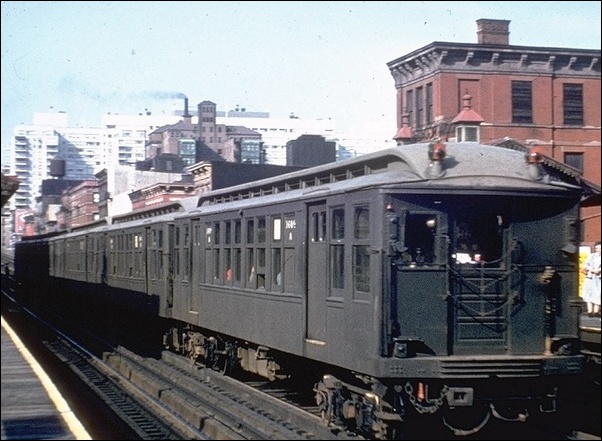
Although a homemade conversion and in some ways strange looking, the MUDC's spelled nostalgia in all ways. Their vestibuled appearance made them look so different from the gate cars from which they were built that seeing a train of each side by side would take a good second look to observe the fact that they were originally the same type car. Depite the fact that the MUDC conversion was strictly an economy job without any major body modifications these cars nonetheless proved to be very reliable and served until 1956, some three decades after their conversion. They were in fact the image of the Manhattan elevated lines until the last line was demolished.
 In 1942 a train of MUDC's rounds the curve from 2nd Ave. at 23rd St. where the 2nd Ave. line crossed to First Ave. 3rd Ave. line express station at 23rd St. is in the background. Robert C. Marcus photo. |
 In their last summer of service, a train of MUDCs awaits a southbound run at Gun Hill Road, 3rd Avenue El., 1955. |
A ride downtown on the Third Avenue elevated, the last remaining such line in Manhattan, on the old MUDC's was such an anachronism and yet the most pleasant way of getting there. Seeing the city from a comfortable old wooden train above ground rather than riding through tunnels! The mellow growl of traction motors, the hush of the air brake system, the smells of ethnic cooking as the trains stopped right near tenement windows in the South Bronx! Unfortunately the powers that be weren't too fascinated with this overhead railroad darkening the streets, nor the noise of the trains on the iron bridge structure with unballasted track, and the last train ran on this line on May 12, 1955. The MUDC's did however serve the Bronx portion of the line for nearly a year afterwards when surplus steel subway equipment replaced them. They were antique in their last years and an odd sight in a world of skyscrapers and modern automobiles but still reliable and a pleasure to ride even though they ranged from 45-53 years old. Unfortunately none have been saved for posterity.
 Here is a company photo showing an MUDC conversion under way. Actual conversion looked somewhat different from this. IRT Company photo. |
 Car 1276 leads a northbound MUDC consist at 34th St. on the 3rd Ave. line. The 1902 version of these cars was distinguished from later portions of the fleet by the external electrical conduit pipe feeding the markers and headlight. Robert C. Marcus photo. |
 An express train of MUDC's on the 3rd Ave. el. This seven car rush hour consist was an example of the longest trains run on the Manhattan els. Robert C. Marcus photo. |
 MUDC 1802 with train laid up between rush hour runs at 156th St.-3rd Ave. This was one of the last cars built for the Manhattan elevated lines in 1911. Van Dorn style link and pin couplers served on the wooden el cars until their demise. Compliments of Nate Gerstein. |
 MUDC 1217 on the 3rd Ave. line in its younger days! Many years of faithful service remained for these cars. Victor Rucklin collection. |
 A train of MUDC's arrives at 200th St. on the 3rd Ave. line in the early 1950's. These 1910-11 cars were bound for lower Manhattan in a service that would soon be history. Franklin B. Roberts photo. |
 MUDC's at station stop at 23rd St. on the 3rd Ave. line. Note the "23" in stained glass on the station's bay window. Stairs go to the express platform of this typical Manhattan elevated double-deck express station. Nostalgia! Victor Rucklin collection. |
Section B: The "Q" Cars
The "Q" cars which we are now to read about started their lives out on the Brooklyn Rapid Transit lines and ended their days there, on the last line in Brooklyn to employ wooden equipment, but since they had served at times on IRT routes and ended their days with some IRT equipment on them they will be written about in this transitional chapter from Manhattan lines to Brooklyn lines.
These cars started life out as open platform, gate, fully electric coaches in 1903 and 1907 when they were delivered as the 1200 and 1400 series of cars. They share some of the story of the IRT MUDC's but go beyond to much more adventure and technology. Rather than being of all wood construction they had a steel chassis with a concrete composition flooring, although their sides, ends, and roofs were completely of wood. They had been in service for some 30 years on the BRT and BMT system, when the World's Fair of 1939-40 was being planned for New York. The Queens lines of the Interborough system were at that time the Astoria and Flushing lines over which the BMT system had trackage rights. Although the BMT had modern subway equipment at the time, these lines had clearances for IRT equipment which the BMT subway equipment would not clear, hence the BMT had no choice but to run their old wooden elevated equipment over these lines. As the site of the World's Fair was to be on the Flushing line the BMT felt it had to get some modern equipment to show off to its World's Fair passengers.

A major investment in new, smaller cars for this route for this brief period was not in order. The plan was to modernize and modify existing equipment for this line and the 1200 and 1400 type coaches were selected for modernization. As the BMT used letter designations for classes of cars these became known as "Q" cars, for the Queens lines. A total of 30 "Q" sets of three cars each were converted, numbered 1600-1629, A, B, C. The A and C cars were motors, or powered cars, and the B cars were trailers, or nonpowered cars. There were also two car sets of "QX" class converted which were identical except for being two car units instead of three car units. These were numbered 1630-1642 A and B.

The idea was the same as the IRT's MUDC conversion; eliminating the open platform design and having remote control doors. However the BMT did a considerable remodelling job. The open platforms were enclosed and seats and motorman's cabs installed there, and the doors were to be installed in the car sides rather than at the ends. Vestibules were non-existent on these cars, openings were cut, remote controlled sliding doors (pneumatically powered) were installed. The result was an attractive car that looked like it had been built that way and not converted. These cars served not only through the World's Fair but until 1949 when the Astoria line was modified for BMT subway trains and thru service was run from the BMT subway in Manhattan to Astoria over the el. The Flushing line was given over to the IRT and remains so until this day; it should be noted here that IRT and BMT are only division designations now as the city has owned the entire system since 1940 and the former private railway companies no longer exist.
As these "Q" cars became surplus equipment at this time, and the former IRT (Interborough) 3rd Avenue elevated line in Manhattan still had some of the non-converted, open platform gate cars, no doubt for rush hour operation only, (many still showed on the roster until 1950) it would have seemed the most likely place to transfer these surplus cars to. However, at this time there were other BMT elevated lines using open platform gate cars with the resultant high manpower costs. The 3rd Avenue line was to get these cars though; BMT cars that had served along with IRT stock in Queens, running with Manhattan el equipment there, were now to visit with their old running mates on 3rd Avenue! More modifications were to take place on the "Q" cars now, and they would spend the rest of their lives being part-Interborough cars!
The marker lights were moved from outside of the clerestory section of the roof to the inner part, giving the cars the best appearance of their career. As they were partially of steel, and the 3rd Avenue line was not built to handle heavier equipment, the lightweight, maximum traction trucks of the former IRT subway composite cars, which had been transferred to the elevated in 1916, were installed on the "Q" cars for the same reason they were installed when the composites were transferred from the subway to the el: To reduce weight. More will be told about the composites later in the subway section. They had, however served the Manhattan els longer than they served the subway for which they were built, but were overshadowed in the subway by the steel equipment before they were outlawed from the subway and then lived in the shadow of the MUDC's on the el.

The lightweight trucks had a motor on each truck rather than both motors on one motor truck with the other truck trailing. This would distribute weight better on these lightly-built structures from the 1870's. The B cars, which were trailers, were not modified as they were lighter, lacking motors and control equipment. They kept their original BMT trucks. The two car "QX" units were never transferred to the IRT and finished their days as work cars on the BMT lines. In 1950, after modifications were completed these cars were placed in service on the 3rd Avenue el, last of the elevated lines of the old Manhattan system. They did not however, supplant the MUDC's but were run only in rush hours to supplement service as they were still rather heavy and only carried passengers on the 1916-built express track, southbound in the morning rush and northbound in the evening rush.
After the abandonment of the Manhattan portion, the major portion of the line on May 12, 1955, they also ran along with the MUDC's on the Bronx part of the 3rd Avenue line until 1956, when surplus steel subway equipment replaced them.
It would seem that by now they would have joined the MUDC's in whatever train heaven there might be, but there was still a call for their service. There were three elevated lines in Brooklyn from the days of steam, that still used wooden cars, surviving in Brooklyn after the demolition of most of the els around 1940. The Lexington Ave. (Brooklyn) line which was mostly a connection between the Myrtle Ave. and Broadway-Jamaica lines, was demolished in 1951; the Fulton Street line had an outer portion from East New York in Brooklyn to Richmond Hill in Queens that survived until 1956, the portion in Queens used as an extension of the IND subway after that time; and the Myrtle Avenue line ran from downtown Brooklyn to Middle Village in Queens. The Fulton Street line's cars were of the converted-from-open-platform "C" class, a forerunner of the "Q" conversion, which were retired when their services were no longer needed on their habitat; the Myrtle Avenue line still had open platform cars of the same vintage as the "Q" cars but as we have already seen these open-platform gate car trains needed a rather large crew. As it was found that the Myrtle Avenue line was still heavily travelled and could not at that time be abandoned it was decided to send the "Q" cars to Myrtle Avenue; they replaced their open-platform, former running mates there although they were equally as old, only because with their remote control doors they could be run with fewer trainmen.
 In late 1958 the "Q"s had their rooves lowered, and this is how they would look until the end of their days in 1969. This Metropolitan Ave. bound train is arriving at Vanderbilt Ave. It has already seen 60 years of service. |
 The "Q" cars have cosmetic surgery again. When they were transferred to 3rd Ave. their marker lights were moved to the same location as on the IRT cars. The "Q"'s were their handsomest during this period. This set of "Q"s is running thru a "foreign land" (Manhattan) on a nearly foreign railroad (the IRT)! Collection of Joe Testagrose. |
From 1958 until October 4, 1969, they lived out their days on the Myrtle Avenue elevated line of the former BMT system, where they had no doubt run many miles before they were remodelled and sent to Queens and then to 3rd Avenue. One more major modification was done to them when they were sent back to the BMT. As East New York was no longer a main shop for the BMT, and these cars would have to be sent through the subway to the only BMT main shop at Coney Island, their high clerestory roofs had to be cut down to clear the subway tunnels. They still looked like old wooden elevated cars after this was done, and they were still a nice piece of history, but this handsome looking fleet of equipment had its looks damaged considerably after those high clerestory roofs only rose a few inches over the rest of the rooffine. After service of nearly two-thirds of a century these gallant old cars were finally retired after the Myrtle Ave. line below Broadway-Myrtle station was abandoned and demolished; the last wooden passenger trains that had been employed in regular service anywhere in the USA ran their last scheduled trips on October 4, 1969. There were a few railfan specials after that, one set of "Q" cars was kept for the Transit Museum in Brooklyn, and another three car set was actually converted partially to its original appearance complete with open platforms and gates! They are not completely original but it is nice to see that somebody had the foresight to preserve some few wooden, electric railway passenger coaches for future generations. Ironically enough, these cars still have the motor trucks from the IRT which were home built by the IRT in 1916 for reasons already mentioned; marker lights mounted IRT style, contact shoes (for 3rd rail power) from IRT Low-V steel subway cars which were retired, rooves nearly a foot lower than when built. Incidentally, these last remaining remnants of the early days of electrification had low voltage control systems which we will study later and shared some mechanical features of BMT steel subway cars which even steel trains built in the 1930's for other svstems did not share!
Section C: The Brooklyn Elevateds

The Brooklyn elevated system was just as extensive and diverse in equipment as the Manhattan el, but of course being in Brooklyn its existence was rather obscure to those who thought of New York City as being Manhattan. Brooklyn had once been a separate city and was almost four times as big a piece of real estate as Manhattan and was home to over two million people.
The Brooklyn els had about as diverse a fleet of equipment as did the BMT subway system. There were again many leftover coaches that had formerly been steam-hauled and were converted to electric multiple unit operation.
The oldest of the motor cars in existence up to the early 1950's were center door cars in the 600 and 700 series. They had open platforms and gates as did the rest of the el fleet but also had a center door. These could still be seen as late as 1955 or so in the yards and were used as work equipment. Another strange piece of equipment was the arch roof 1000's which had been run on the southern lines toward Coney Island but which were gone when the last of the southern lines to be part of the elevated division, the 5th Avenue and Bay Ridge Line, was demolished about 1940.
The last of the open platform BMT, ex BRT elevated cars to be in passenger service on the Brooklyn elevateds were the 1300 series, built in 1904 and 1905. These were quite different from most elevated equipment as they had nearly all walkover type cross seats which could be flipped over to face the train's direction of travel. The great majority of elevated coaches had fixed seating, mostly longitudinal, with four sets of fixed cross seats in the center of the car. This arrangement made for easier movement of passengers who boarded and alighted from the cars at the many stops made along the line and provided more standing room. However the seating arrangement of these 1300's was just like conventional railroad coaches. Additionally the 1300's had window sashes that could be removed in summer, with shades to protect passengers from inclement weather. Windows on these cars could not be opened as on most railway coaches but since those sashes were removable for summer such was not necessary. In their last years only four center sashes on each side of these cars were removed during the summer months. This was a pattern which had become popular on trolleys about the time the 1300's were built and the design was known as "convertible". The 1300's were part of a series of cars called BU class, and also included 1200 and 1400 series built about the same the 1300's were built.
As on the 1200 and 1400 series, the 1300's were constructed partially of steel, this time it was the lower portion of the cars sides; but they did have truss rods to keep the floor from sagging as was practice on wooden railway cars. These also had low voltage controls and automatic air brake.
Little mention has been made of the 1200 and 1400 series which were used for the modified "Q" and "QX" classes which we have already read about, but some of these were left in their original state, and one of them, 1227, could still be seen in the yards used as a work car as late as 1959.
The strangest looking cars of the Brooklyn el fleet were the "C" type cars which were converted from open platform cars in the early 1920's but which were a home-made looking car and not as professionally rebuilt as the "Q" cars were. These were number 1500-1529 A, B, and C and as on the "Q" cars they were semi-permanently coupled in three car units and had controls only on the ends of the three car units. The A&C cars were motor cars converted from 1200 and 1400 series, and the trailers converted from 1893-built steam cars. These cars were in service on the Fulton Street Line and last ran in 1956 when most of the remaining portion of that line was abandoned and the remainder given to the IND, for operation of subway trains. The "C" types had retained their original braking equipment but when they were converted they received subway type controllers which were made surplus by the single standard steel cars being converted to three car units, a mania which the BMT seemed to have.
The "C" types had the nickname "ugly duckling," unfortunately a well deserved name. They not only had unsymmetrical roof line and the "B" car being higher and having a big steel truss grider under the floor upset their appearance farther. There was also a side extension built onto these cars at floor level to fill in space between the car and the platforms at stations, as from the 1930's on some trains of lightweight experimentals with subway dimensions which were wider were run on the Fulton Street Line. Until their demise in 1956 they shared their route with the lightweight steel "MS" or Multi-Section cars which ran from Manhattan over the 14th Street Line and connected with the Fulton Street Line in East New York during rush hours. Another strange feature of these cars was having all longitudinal seating which was uncommon for elevated line coaches. Despite their appearance (let us say that beauty is in the eyes of the beholder) they served quite well and put in service beyond the call of duty for their many years on the line. None of the "C" types were saved in a museum anyplace; they were all disposed of after their home trackage was taken out of service.
This was ironic because the last of the Brooklyn lines to have wooden equipment was served out of the East New York Shop as well, and the open platform 1300 series were employed at that time, on the Myrtle Avenue line. During the rush hours there were five car trains with a five man crew on that line; perhaps the "C" types with their multiple unit door control, enclosed ends, and smaller crew requirements had already been modified beyond further conversion for service on Myrtle Ave. or most likely because there were plans to put the "Q" cars on Myrtle Ave. In any event the 1300 series of "BU" cars remained in service until the spring of 1958 on the Myrtle Avenue line. At that time our old friends, the "Q" cars were placed in service on Myrtle Avenue, replacing the last open platform cars anywhere on the system.
We already know from reading the section on the "Q" cars that the story of wooden passenger equipment doesn't end with the disposal of the "BU"s. The "Q" cars served for another 11 years when the book was closed on regularly scheduled operation of wooden cars in passenger service in Brooklyn, on the New York City transit system, and indeed in the entire United States forever. It is quite ironic that these cars existed until 1969, but the Myrtle Avenue line was considered necessary until then and heavier steel subway cars could not be run there.
It is regrettable that none of the familiar Interborough (IRT) elevated rolling stock was saved for future generations to see, study, and enjoy but happily the old Brooklyn equipment has some representative cars in museums. The Branford Trolley museum near New Haven, Connecticut has Instruction car 999, and coaches 659, 1339, and 1227.

The New York City Transit Museum in Brooklyn has a set of "Q" cars and has re-converted another set of three class Q cars to open-platform "BU" cars, numbers 1404, 1273, and 1407. Unfortunately they are not totally restored to their original selves but at least an effort has been made to show the public how it once was when one could ride these cars around the city.
There are 2 former Manhattan El/IRT cars at Branford Trolley Museum in Connecticut but those were both non-revenue cars.
 Here is a trailing coach of the Brooklyn elevated, built to be hauled behind steam and later converted for electric operation. This car was retired in 1940. BMT Photo. |
 A Coney Island Bound typical mixed consist of BMT el cars leave 9th Ave. in Brooklyn on the Culver Line in 1937. Above it is a city-bound West End line train of the "A-B" class steel cars. |
 Three-car train of 1300 series wooden "convertible" cars at Coney Island yard. All window sashes are in place. Franklin B. Roberts. |
 Interior of a 1300 series BU convertible. Walkover seats were unusual on the els. Franklin B. Roberts. |
 Former BMT instruction car 999 at the Branford Trolley Museum being restored. This car looks more like a former interurban than an el car. Photo by Harv Kahn. |
 It is 1914 and train service was running over the Brooklyn Bridge; this is the Manhattan end of the Bridge, facing Park Row terminal. Note trolley cars, horse drawn vehicles, many people afoot, and their clothing. |
 A BMT Fulton St. (Brooklyn) el train passes Borough Hall in 1938 on its way to Richmond Hill and several neighborhoods in between. |
 This BU car was dolled up for a fantrip, after these last gate cars were taken out of service in 1958. All window sashes were removed from this car, which was not normal practice in the last years. |
 Much like the IRT composites, the "C" types of the BMT were a hodgepodge of homebuilt remodelling. The end cars of each unit appear to have been converted from 1200's and 1400's like the "Q"s. The center car had a higher roofline and a fishbelly. No doubt these side extensions were added because part of the line was used by the "Multi's" which were built to BMT subway width. The C's were assigned to the Fulton Street line. This scene at Crescent St. Robert C. Marcus. |
Copyright 1985 by Edward C. Davis, Sr. Reproduced on nycsubway.org with permission. Webmaster's Note: The photos presented in these articles were in many cases scanned from the original slides obtained from the author. Where the original slides weren't available, scans from the book are used. In a few cases, similar photos from the collection of nycsubway.org were used instead of the low-quality scans from the book. These are all noted as such in the captions.
| ||||||